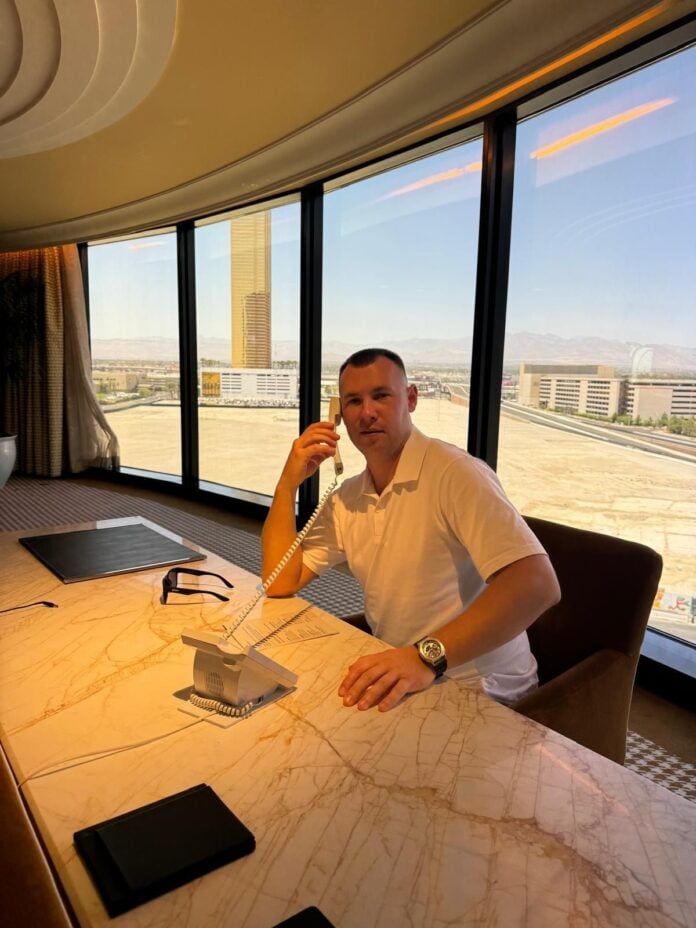
Over the past fifteen years, Ivan Brazhnikov has undergone a unique journey from sales specialist to entrepreneur managing various companies. His professional experience encompasses human resources management, organizing construction and engineering projects, working with contractors, business development, and coordinating complex operational processes. Today, Ivan is responsible for highly complex projects. In this interview, he discusses the principles of effective management, small business development, and why high-quality process organization is one of the key factors in economic growth.
Ivan, your education is in finance, economics, and management. Why did you choose this path?
Even in my youth, I noticed a passion for studying business processes. I was interested in issues of internal organization and improving business efficiency. That’s why I first studied finance and then went on to study Economics and Enterprise Management.
You’ve been an entrepreneur for many years. Which projects have been most significant for you?
At various stages, I developed several companies in the fields of engineering systems, facility automation, security systems, and retail. In all projects, I was responsible for client acquisition and the organization of the full work cycle: from negotiations and procurement to contractor management and quality control. This experience allowed me to understand how small and medium-sized businesses operate and what problems most often hinder their development.
Tell me about the most common challenges small businesses face.
The most common problems are related to inefficient process organization. Many companies waste resources due to the lack of a clear HR management system, inadequate contractor oversight, planning errors, and poor coordination between project participants. Even a successful product doesn’t guarantee business growth if the company lacks high-quality operational mechanisms.
You’ve worked as an entrepreneur in both Russia and the US. What differences have you noticed?
In the US, the role of standardized processes and management approaches is significantly higher. Here, great attention is paid to the precision of operations, the responsibility of contractors is emphasized, and long-term planning is used. At the same time, the problems of small businesses are largely universal. Entrepreneurs in any country need effective tools for managing resources, personnel, and projects in general.
In 2023, you founded a service company in California. What was the foundation for its development?
The key factors were understanding client needs and a strong internal organization. I was personally involved in marketing, advertising, cost estimates, contractor selection, and project coordination. This allowed me to fully control the quality of services at every stage and ensure a high level of client satisfaction.
Over the years of entrepreneurship, you’ve handled a large number of projects. Can you provide an example of your results?
During my time working in the field of automatic gates, engineering systems, and service, I personally supported numerous projects of varying complexity. These included both private and commercial clients. My goal was to ensure the full project cycle, from the initial meeting with the client to the completion of the project. For me, the most important indicator was always that clients recommended the company to their friends and returned again.
How large a team did you manage?
Depending on the project, up to 200 specialists could be working simultaneously, including contractors, installers, suppliers, and technical specialists. It was important to organize the work so that everyone understood their tasks and deadlines.
What financial results do you consider the most significant?
In one of my projects, we managed to increase sales by approximately 35 percent by changing our approach to working with clients. We didn’t increase the advertising budget, but focused on service quality, order processing speed, and streamlining internal processes.
Have your solutions ever resulted in significant savings for the company?
Yes. After revising the procurement and work planning framework, we were able to reduce operating expenses by 20 percent. We eliminated unnecessary purchases, optimized logistics, and more effectively distributed the workload among contractors.
You currently work in operations management. What challenges do you face?
My work involves staff coordination, contractor management, logistics organization, project support, and real estate administration. Essentially, it involves creating methods and algorithms in which a large number of mechanisms work in concert and produce tangible results.
Ivan, many people perceive an operations manager as an administrator. What does this job actually entail?
In my view, an operations manager is responsible for ensuring the smooth operation of many people and areas. These include contractors, suppliers, logistics, deadlines, budgets, and, most importantly, quality. If even one element falls through, the entire project falls apart. Therefore, my job has always been to ensure the smooth operation of all parties.
Let’s talk about your business, which manufactures automatic gates and security systems. In your opinion, what were the most challenging tasks?
It was a full-cycle job. I negotiated with clients, organized equipment procurement, coordinated delivery schedules, coordinated installation teams, and oversaw the handover of projects. I also had to interact with several contractors and suppliers simultaneously. I can’t say it was difficult. Rather, it was a great responsibility. And I believe I managed to handle it.
What distinguishes a strong operations manager from an ordinary executive?
In short, a manager can set a task. The operations manager is responsible for ensuring that this task is completed on time, within budget, and with the desired results.
How has your experience working with engineering systems influenced your professional approach?
Working with engineering systems requires a very high level of precision. You can’t start the next stage if the previous one is completed incorrectly. There, I learned to plan the sequence of work, take into account dependencies between contractors, and anticipate potential risks.
Was there a project that you consider a turning point in your career?
Absolutely. One of the most challenging projects involved organizing the installation of engineering systems, where several contractors and suppliers were working simultaneously. Any error could have led to missed deadlines. I managed to establish communication between all participants, organize the sequence of work, and ensure that commitments to the client were met. I am continually convinced that competent management is often more important than the volume of resources.
In your future project, you plan to engage in business consulting and organizational management. Why is this area relevant for the United States?
Small and medium-sized businesses make up a significant part of the American economy. However, many companies face growth challenges precisely because of internal organizational constraints. Improving process efficiency helps reduce costs, increases labor productivity, improves service quality, and creates new jobs. Therefore, the development of modern approaches to operations management has practical significance for the economy as a whole.
What do you consider your greatest professional achievement?
For me, my greatest achievement is the ability to successfully work at the intersection of different fields: entrepreneurship, project management, HR, and operations management.
Ivan, thank you for the conversation. We wish you continued professional success!
Igor Krasin