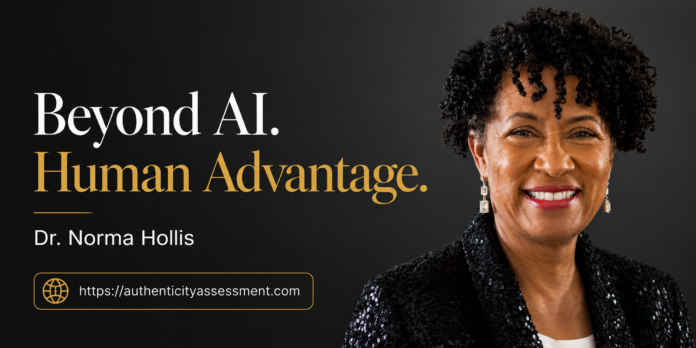
After more than four decades of studying what makes people distinctly human, the “Godmother of Authenticity” says her life’s work has arrived at its most important moment.
Long before authenticity became a leadership buzzword, a branding strategy or a social media hashtag, Dr. Norma T. Hollis was asking a deeper question: What makes each person uniquely who they are, and what becomes possible when they learn to use that knowledge intentionally?
For more than 40 years, Hollis has studied the connection between authenticity, success, leadership and human potential. Her journey has moved through early childhood education, professional speaking and entrepreneurship, but the thread running through every chapter has remained the same: an enduring curiosity about how people are designed to think, communicate and act.
Now, as artificial intelligence rapidly changes the way people live and work, Hollis believes that inquiry has taken on new urgency.
“We must develop our Authentic Intelligence as intentionally as we develop AI,” she says.
It is a timely declaration from a woman widely known as the “Godmother of Authenticity.” Hollis is not entering the AI conversation as a technologist. She is entering it as a longtime researcher and architect of human capacity, one who believes the future will depend not only on what machines can produce, but also on whether people understand the qualities no machine can replicate.
A Calling That Revealed Itself
Hollis did not begin her career with a master plan to build a body of intellectual property around authenticity. In many ways, she says, the work chose her.
As a child, she was the one asking questions, observing what others overlooked and wondering why people behaved as they did. At the time, those instincts made her feel different. Years later, they became the foundation of her professional life.
Her entry into the speaking industry came through Speakers Etcetera, the speaker bureau she founded after recognizing her ability to identify compelling voices and connect them with audiences. While helping other people build speaking careers, Hollis discovered that she had a message of her own.
That realization launched a decades-long evolution from bureau owner to professional speaker, trainer, author and thought leader. Along the way, she spoke to audiences across industries and around the world, developed certification programs and created tools that allow other practitioners to apply her work.
The path was not always easy. One of her greatest professional challenges was being ahead of the conversation. Hollis was researching and teaching authenticity before the business world had an established vocabulary, or an obvious market, for it.
Rather than abandon the idea, she built the language herself.
Authenticity Is More Than “Being Yourself”
Hollis is quick to challenge the familiar, simplified definition of authenticity. In her view, it is not merely permission to “be yourself.” It is a capacity that can be understood, measured and developed.
Her research led to the Authenticity Grid®, a framework identifying nine dimensions of authenticity, and the Human Energy Operating System™, an architecture designed to help people understand how their distinct qualities shape the way they live, lead, communicate and perform.
The difference is important. A slogan may inspire someone for a moment; a system can give individuals and organizations a practical way to examine behavior, develop leaders and strengthen workplace culture.
That is why Hollis increasingly positions authenticity as a business and leadership strategy. For organizations facing rapid technological change, employee disengagement and growing pressure to build trust, understanding human energy is not a soft concern. It can influence communication, decision-making, collaboration and performance.
Her concept of AI² brings that idea into sharp focus: Artificial Intelligence plus Authentic Intelligence. The point is not to resist technology, but to ensure that human development keeps pace with it.
The Human Advantage in an AI-Driven World
AI can draft, calculate, predict and imitate at extraordinary speed. But Hollis’s work raises a more consequential question: If technology can increasingly reproduce what people do, do people understand who they are?
For leaders, educators, coaches, speakers and entrepreneurs, the answer may shape the next era of work. Technical ability alone will not create trust. Efficiency alone will not inspire loyalty. Information alone will not provide wisdom, courage, discernment or meaningful connection.
Those capacities begin with a deeper understanding of the human being using the technology.
This is where Hollis sees her work expanding. Her vision is for the Human Energy Operating System™ and Authenticity Grid® to become widely used across business, education, coaching and leadership development. She is also preparing other coaches and practitioners to teach the work, allowing the framework to reach well beyond her own speaking platform.
For aspiring and established Black speakers, her career offers another lesson: experience and perspective can become more than a presentation. When carefully studied, named and organized, they can become intellectual property, a lasting body of work capable of teaching others and creating impact across generations.
Dr. Pam Perry, publisher of SPEAKERS Magazine, has called Hollis the “G.O.A.T. of Black Speakers,” a description that reflects both her longevity and her influence. Yet Hollis is not treating this stage of her career as a victory lap.
She sees it as a beginning.
A Legacy Built for What Comes Next
After four decades of research, speaking and refinement, the pieces of Hollis’s work are converging at the same moment the world is wrestling with the meaning of humanity itself.
Her goal is not simply to secure another keynote or introduce another program. It is to leave behind a framework that continues helping people recognize what makes them different, and use those differences as strengths rather than liabilities.
The woman who spent years ahead of the conversation may have arrived precisely on time.
As organizations race to invest in artificial intelligence, Hollis is asking them to make an equally important investment: develop the people who will lead it, question it and decide how it should be used.
Because in the future of work, the most important intelligence may not be artificial at all.
Connect with Dr. Norma T. Hollis at NormaSpeaks.com