Key Takeaways
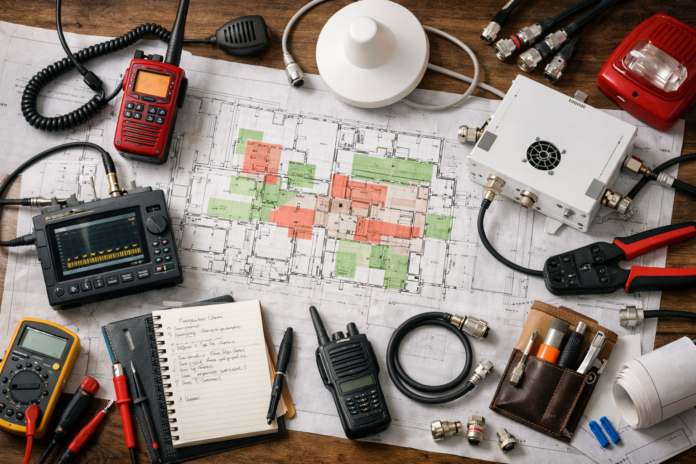
- Start with a grid test, not a parts list. In New York retrofit work, an emergency radio communication system usually fails first in stairwells, basements, mechanical rooms, and areas changed by new occupancy loads.
- Know the language before submittals go out. Contractors who can explain the difference between ERCES, ERRCS, BDA, and ARCS in plain field terms avoid bad equipment matches and costly redesigns.
- Tie code to install decisions early. IFC, NFPA, UL 2524, and local AHJ review now shape donor antenna placement, battery backup, monitoring, and acceptance testing on almost every public safety radio job.
- Check installability before purchase. The best emergency radio communication system for a contractor isn’t the flashiest box—it’s the one with open commissioning access, clear alarms, solid band support, and tech support that actually answers during startup.
- Plan around testing, not hope. Better pathway routing, antenna verification, labeling, and channel planning cut rework during acceptance testing and reduce call-backs after sign-off.
- Treat retrofit coordination as a life-safety issue. In dense New York and New Jersey buildings, emergency responder communication depends on tight coordination with fire alarm, electrical, DAS, and building management from pre-bid forward.
Retrofit work is exposing a hard truth in New York: plenty of buildings that look fine on paper still fail the radio test where it counts. An emergency radio communication system can pass submittal review and still fall apart in stair towers, below-grade spaces, mechanical rooms, and shielded tenant buildouts once real testing starts. That gap is showing up more often now—right when Local Law work, occupancy changes, and tighter AHJ scrutiny are forcing older properties back under the microscope.
For low-voltage and fire alarm contractors, that matters.
A weak donor signal, a bad passive DAS layout, or battery calculations that looked acceptable in the office can turn into failed acceptance testing, extra truck rolls, and a stalled C of O in the field. And in New York, where dense construction, steel, concrete, and agency requirements don’t leave much room for guesswork, those misses get expensive fast. The honest answer is that retrofit jobs tell the truth—fast—about which systems are built for installability and which ones create headaches after the walls are closed.
Why emergency radio communication system failures are showing up during New York retrofit projects right now
A Manhattan high-rise clears a fire alarm upgrade, then fails radio testing in two stairwells and a below-grade loading dock. A Brooklyn school converts old office space to student support rooms, and police channel traffic drops out near the elevator lobby. That’s what retrofit work is exposing right now.
In New York, Local Law work, occupancy changes, — tighter AHJ review are forcing owners to test what older buildings only assumed was fine. An emergency responder radio system can look acceptable on paper and still miss distress calling coverage where first responder traffic matters most—stairs, pump rooms, electrical closets, and deep interior corridors.
How Local Law upgrades, occupancy changes, and tighter AHJ review are exposing weak in-building radio coverage
Bluntly, retrofit permits now trigger closer code review of the full emergency radio communication system, not just the fire alarm scope. A hospital floor re-stack, a mixed-use tenant fit-out, or a management change in use group can expose an aging in-building emergency radio system that was never tested to current expectations in New York City.
- Stairwells lose signal first
- Basements and generator rooms follow
- Shielded additions create dead spots fast
Where older high-rises, hospitals, schools, and mixed-use buildings lose responder radio signal first
The weak points are predictable—even if the reviews aren’t. Older concrete cores, hospital imaging areas, school retrofits with added security glazing, and mixed-use podium levels often break a public safety radio communication system long before anyone hears the warning during a live call.
That’s why contractors should test the fire department radio communication system early, before closeout. In practice, 95 percent grid testing, stairwell checks, and rooftop-to-cellar band verification catch problems while there’s still room to fix antenna locations and channel coverage.
How an emergency radio communication system actually works inside a retrofit building
What’s really happening above the ceiling when a retrofit crew installs an emergency radio communication system in a stubborn old New York high-rise? The short answer: the system captures weak outside radio signal, conditions it, distributes it through the building, and keeps that path alive during a fire, power loss, or distress call—if the layout and supervision are right.
The difference between ERCES, ERRCS, BDA, and ARCS in plain contractor language
Contractors hear four labels for almost the same job, — that confusion wastes time in submittals. ERCES and ERRCS usually mean the same in-building life-safety coverage concept; BDA is the amplifier piece; ARCS is the New York City flavor tied to local code and FDNY expectations. In plain field language, an emergency responder radio system is the full package, not just the box on the wall.
For retrofit work, a properly engineered in-building emergency radio system has to match the building, the band, and the AHJ—not the sales sheet.
Core components that make or break code-compliant emergency responder communication indoors
A reliable public safety radio communication system usually comes down to five parts:
- Donor antenna with clean roof placement
- BDA or head-end equipment
- Passive DAS with splitters, coax, and antennas
- Supervision for faults and antenna issues
- 24-hour battery backup and alarm tie-in
The fire department radio communication system fails most often at transition points—bad connectors, wrong coax loss math, or donor placement facing city noise instead of the serving tower.
Here’s what that actually means in practice.
Why passive DAS layout, donor antenna placement, and battery backup usually decide field performance
Here’s what most people miss: passive DAS is where the job is won or lost. A donor antenna can test fine on the roof, then fall apart after install because steel, parapets, and nearby radio traffic in New York or Jersey shift the channel behavior inside the building (especially on 700/800 MHz). And if standby power is undersized, the emergency radio communication system won’t hold through a real event. That’s not a punch-list issue. It’s a failed inspection—and worse, a dead radio path for first responder traffic.
New York code pressure is changing how contractors specify emergency radio communication system equipment
Specs are tightening.
In New York, a missed note on riser coordination or battery calculations can turn a clean install into a failed inspection—the answer is earlier code mapping — less guesswork around the emergency radio communication system.
What IFC, NFPA, UL 2524, and local fire department requirements mean on real jobs
On real projects, contractors are balancing IFC Section 510, NFPA pathways, UL 2524 listing requirements, and local fire department amendments that don’t always read cleanly together. A compliant public safety radio communication system has to be planned with survivability, monitoring, battery standby, antenna placement, and acceptance testing in mind—not after rough-in.
That’s where an emergency responder radio system differs from a basic two-way radio setup used for dispatch, police tactical channel work, or marine distress calling. It’s a life-safety system tied to code, not a Kenwood or Baofeng UV-5R radio choice.
Let that sink in for a moment.
Why New York, New Jersey, and dense urban markets demand tighter coordination with fire alarm and public safety stakeholders
Dense city work changes everything.
Steel, low-E glass, below-grade spaces, — shared telecom rooms make an in-building emergency radio system harder to pass in York, Jersey, and similar state markets.
- Coordinate donor antenna locations early
- Match fire alarm monitoring points to the radio head-end
- Confirm channel, band, and signal thresholds with the AHJ before trim-out
The inspection and acceptance testing issues that stall sign-off, call-backs, and certificate of occupancy
Three problems show up again and again: weak grid-test spots, incomplete alarm/trouble/supervisory reporting, and bad documentation. A fire department radio communication system can look fine on paper and still fail acceptance if the message logs, warning indicators, or backup power sequence don’t match the approved set.
In practice, manufacturers like Marconi Technologies see most delays hit during final test week—right when the certificate of occupancy is on the line.
What contractors should look for before they buy an emergency radio communication system
Roughly 1 out of 3 retrofit delays in New York come from paperwork and commissioning bottlenecks, not bad cable pulls or weak radio math. That catches people off guard. On a tight city job, the right emergency radio communication system is usually the one a crew can install, test, and hand over without waiting three extra weeks for somebody else’s tech.
The installability question: non-proprietary controls, commissioning access, and field support that answers the phone
Start with access. If the emergency responder radio system locks basic programming, alarm setup, or channel changes behind factory-only credentials, margins disappear fast. In practice, a solid in-building emergency radio system should let qualified contractors handle commissioning, signal checks, and distress alert verification without a manufacturer gatekeeping every call—because that delay is what kills closeout.
And support matters. A true fire department radio communication system needs live field support that answers when the panel throws a warning at 6:15 p.m. before inspection.
Which submittal items matter most: band support, channel planning, monitoring, alarms, and shop drawings
Skip the fluff. Contractors should verify:
Simple idea. Harder to get right than it sounds.
- Band support: UHF, VHF, 700/800 MHz
- Channel planning: police, first responder, dispatch, and tactical paths
- Supervision: antenna monitoring, battery alarms, donor failure points
- Drawings: stamped shop drawings and clean riser details
A dependable public safety radio communication system also needs code-ready documentation for AHJ review in New York and Jersey markets.
Why the best emergency radio communication system is usually the one that passes fast and comes back least
Simple. Fewer proprietary parts, clearer alarms, and cleaner submittals mean fewer callbacks. That’s what contractors should buy—an emergency radio communication system that passes the first inspection, keeps the radio channel stable, and doesn’t come back six months later with nuisance trouble signals.
What retrofit jobs teach about building a reliable emergency radio communication system from day one
Retrofit work exposes design mistakes faster than new construction ever will.
-
Pre-bid checks that catch distress areas, dispatch dead spots, and hidden coordination costs early
Before pricing, contractors should verify existing radio coverage in stairwells, elevator lobbies, pump rooms, and below-grade spaces—those are the spots where a missed channel usually turns into a failed acceptance test. In New York and jersey border markets, a proper walk test with the local fire department radio communication system or other AHJ-approved gear will flag weak communications, battery room shielding, and rooftop pathway conflicts before labor gets burned.
-
How to reduce rework during acceptance testing with better pathway routing, labeling, and antenna verification
Most rework starts with bad paperwork and lazy routing. A reliable in-building emergency radio system needs labeled coax, survivability pathways that match code, and antenna spacing confirmed against the floor plan—not guessed in the field. During testing, contractors should document donor levels, passive losses, and antenna verification on every floor, because one loose connector can kill a public safety radio communication system at the worst time (usually when the inspector is standing there).
-
A practical contractor takeaway for New York projects where public safety radio coverage can’t be guessed
For retrofit bids, the smart move is simple:
- run a pre-bid sweep,
- confirm AHJ bands and dispatch requirements,
- price pathway protection honestly,
- and document every test point.
That approach builds a better emergency responder radio system and a more reliable emergency radio communication system—and it keeps the job from turning into a callback factory.
Marconi Technologies
New York, NY 10006
(212) 376-4548
https://www.marconitech.com/
For more great reading, visit our site and explore related topics.