Most of the metal that holds up a ship, a rig or an aircraft is still made the way it was a generation ago. Someone designs a part, a supplier tools up for it, a large plant makes it, and a truck or a ship brings it to where it is needed. When the part is urgent, every one of those steps becomes the delay.
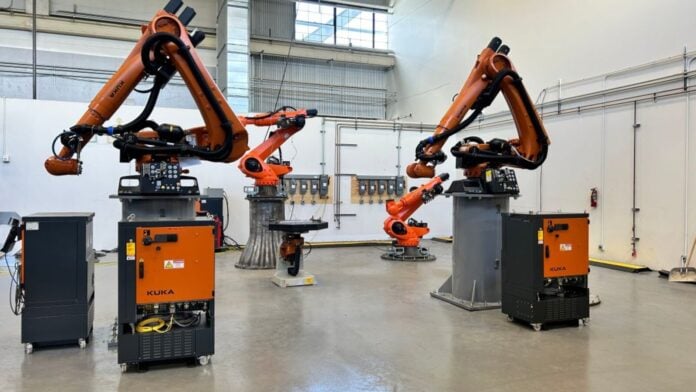
Solideon, founded in 2021 by engineer Oluseun Taiwo, is trying to remove most of them. The company takes off-the-shelf industrial robot arms, the same orange machines found in car plants, and runs them with proprietary software that lets them 3D-print, machine, assemble and inspect large metal structures together. The result is a factory that can be packed into a shipping container and set up close to the job.
A factory that does not need a factory
The pitch is about floor space and headcount. Taiwo has described the goal as doing with a small robot cell the work that would normally take a facility of around 100,000 square feet and roughly a hundred people. The person running it does not need a background in robotics or 3D printing: they describe the part, and the software plans the build.
Solideon’s own figures put the benefit in plain terms. It says its systems can remove more than 90% of the human intervention in a manufacturing process, can cut part weight by up to 20%, and need no traditional tooling, a step that on its estimate usually takes four months or more.
Who is buying
The first customers are in defense. Solideon holds a $1.25 million Direct-to-Phase II SBIR contract from AFWERX, the U.S. Air Force’s innovation arm, to build a single-pallet manufacturing cell for expeditionary sites. In 2025 it took part in the U.S. Navy’s Trident Warrior exercise and opened Solideon Defense in Norfolk, Virginia, to make submarine hull sections and other large defense hardware alongside shipbuilder Fairlead.
Commercial uses are lined up behind that work. Taiwo points to offshore oil rigs, where getting a replacement part out to the platform can cost far more in lost time than the metal is worth.
“The future of industrial power isn’t centralized, it’s deployable.”
A new home in Los Angeles
In 2026 the company moved its headquarters from the Bay Area to Los Angeles and now works out of a shared factory space in Inglewood. Taiwo says Solideon has raised roughly $9 million to date, and that more funding is expected.
For a company of its size, the ambition is large. Taiwo calls the Moon and Mars the company’s long-term north star. For now, the work is closer to home: putting factories on the ground where the parts are needed, and keeping them running with people who have never programmed a robot.