Most health technology companies start with a problem and a hunch, not a product. A founder knows that patients forget their pills, or that emergency medication is locked in the wrong cupboard, and has a rough idea of what might fix it. Tomorrow Lab® exists for the long stretch between that idea and a device a factory can build.
Founded in 2010 by Theodore Ullrich and Pepin Gelardi, the studio works from the Greenpoint Manufacturing and Design Center in Brooklyn, New York. Its small team combines industrial design, mechanical engineering, electrical and firmware engineering, and supply chain work under one roof, which means a health client does not have to stitch together three or four separate vendors.
A portfolio that reads like a health tech timeline
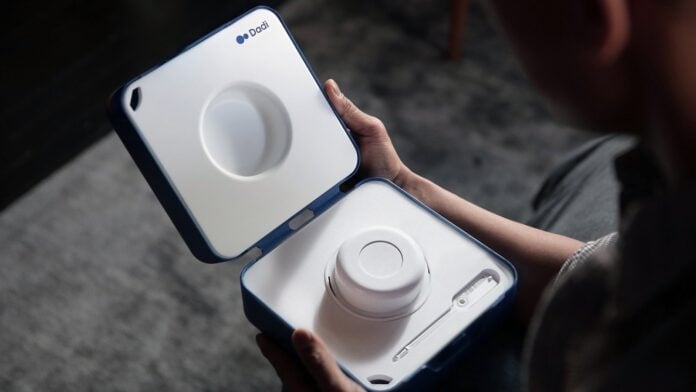
The studio’s health and wellness work spans more than a decade. In the early 2010s it designed AdhereTech’s web-connected pill bottle, which sensed how many pills were left and reminded patients to take a dose. In 2019 it helped launch Dadi, an at-home sperm collection and storage kit whose box doubles as temperature-controlled return packaging. Tomorrow Lab reports that Ro acquired Dadi in 2022 for a reported $100 million.
More recent projects include MedLocker by Belay, a wall-mounted smart station for epinephrine auto-injectors and naloxone, and Diana, a wearable patch from Artemis designed to ease menstrual pain with vibration controlled from a phone app.

Building for each stage
What connects these projects is a process that changes shape as a product matures. Early on, the studio works fast and cheaply, with sketches, foam models and cardboard mockups. Later it moves to working electronics, then to devices built the way a factory will build them. Tomorrow Lab divides the path into twelve phases across three stages: Holistic Innovation, Product Development and Pilot Production.
Ullrich has described the advantage of keeping mechanical engineering, electrical engineering and industrial design on one team as a way of working that
“minimizes risk and disruption while getting products to market faster, cheaper, and better.”
For health clients the stakes of that sequencing are high. Material choices have to suit medical use, electronics have to be reliable enough to trust, and the user is often a patient, a parent or a school nurse rather than an early adopter.
Tom Smith, founder of Dadi, credited the studio’s early visual work with helping the company get started, saying Tomorrow Lab’s
“3D renderings were of great help in raising our first outside capital.”
The client keeps what it builds
Tomorrow Lab’s clients own the work at the end of a project, including creative and research output. For a health startup, whose value often rests on patents and know-how, that matters as much as the device itself.
Tomorrow Lab is a technology innovation studio based in Brooklyn, New York, that invents, prototypes and develops new hardware products for startups and corporate innovation teams. More information is available at tomorrow-lab.com.