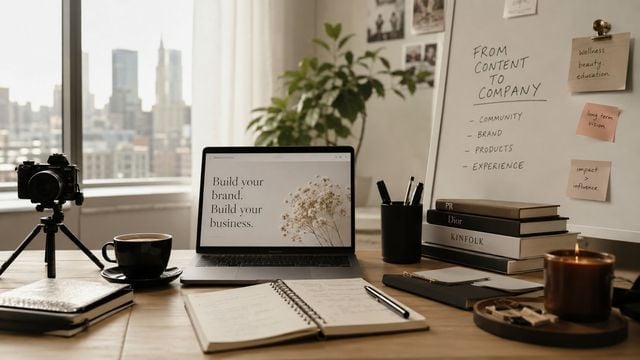
For years, the creator economy revolved around visibility. Success was measured by follower counts, engagement rates, viral videos, and brand sponsorships. But across the American digital landscape, a different trend is becoming increasingly apparent. More creators are no longer treating social media as the final destination — instead, they are using it as a foundation for building long-term businesses.
According to analysts, the global creator economy is expected to surpass $480 billion in the coming years. At the same time, many content creators are beginning to recognize the limitations of a model entirely dependent on advertising revenue and platform algorithms. As audience behavior shifts and competition intensifies, the most successful digital personalities are expanding beyond content creation and entering industries such as wellness, beauty, hospitality, fashion, and consumer products.
One of the most notable examples is Emma Chamberlain, whose rise on YouTube was originally built around an intentionally imperfect and authentic style that sharply contrasted with the polished influencer culture dominating the platform at the time. Rather than remaining dependent on sponsorships alone, Chamberlain transformed her audience into a fully realized business through Chamberlain Coffee, which evolved from an online concept into a brand now carried by major American retail chains.
A similar transition can be seen in the beauty industry. Marianna Hewitt, widely known as a lifestyle and beauty creator, became the co-founder of Summer Fridays — a skincare company that has since grown into one of the most recognizable influencer-founded beauty brands on the market. The success of Summer Fridays demonstrated that audience trust can evolve into long-term customer loyalty extending far beyond social media.
The same pattern is emerging in the podcast industry. Alex Cooper, host of Call Her Daddy, transformed her popularity into a broader entertainment and production ecosystem, reflecting a growing shift in which creators increasingly operate more like media companies than traditional influencers.
At the same time, wellness entrepreneurs are becoming some of the most commercially successful figures within the creator economy. Lauryn Bosstick, founder of The Skinny Confidential, expanded her lifestyle platform into a multi-layered business that includes beauty tools, wellness products, podcasts, and educational digital projects. Hyram Yarbro, who gained popularity through skincare-focused content on TikTok and YouTube, later launched Selfless by Hyram — a brand that combined beauty, sustainability initiatives, and a broader social-impact mission.
Even celebrity-founded brands are reshaping the market. Hailey Bieber’s Rhode Skin became one of the most talked-about skincare launches in recent years, increasing both investor and media interest in beauty companies built around personal audiences. Analysts note that the success of these projects is driven not only by celebrity visibility, but also by the fact that consumers increasingly prefer buying products from people with whom they feel an emotional connection.
This shift is especially visible in the wellness and aesthetics industries, where trust and audience intimacy often matter more than traditional advertising. The American med spa market, which continues to grow rapidly, has become particularly attractive for creators looking to build service-based businesses around lifestyle and beauty communities.
A similar — though smaller-scale — trend is now emerging among rising creators in cities like New York and Miami. Anna Rode, a Russian-speaking lifestyle creator living in the United States, represents a new generation of digital entrepreneurs. Unlike creators whose platforms are built entirely around curated luxury aesthetics, her content is largely centered on live storytelling, everyday observations, and direct audience interaction. Over time, that relationship with her followers began extending beyond social media and gradually evolved into a wellness-focused direction, including the launch of her own med spa project.
According to industry experts, creators who work in a more conversational and documentary-style format often build a higher level of audience trust than those whose image relies solely on aspirational lifestyle content. In many cases, followers stop being passive viewers and instead begin following a creator’s personal and professional journey, creating a much deeper sense of loyalty that can eventually translate into support for real-world businesses.
This evolution also reflects broader cultural changes across the internet. The era of perfectly curated influencer culture is gradually losing some of its influence, particularly among younger audiences who are increasingly drawn to creators perceived as more authentic, transparent, and entrepreneurially minded. Instead of showcasing only the final version of success, many creators now document the process itself — building companies, navigating challenges, and balancing business with everyday life.
As a result, social media platforms are increasingly functioning not only as entertainment channels, but also as modern business incubators. Content creators are launching wellness brands, opening physical spaces, organizing events, building educational platforms, and creating companies rooted not in traditional advertising, but in audience trust.
For many digital entrepreneurs, the future of the creator economy no longer depends solely on virality. Increasingly, long-term success belongs to those capable of transforming online attention into sustainable businesses that can exist far beyond the algorithms.