Adrien Pieuchot has owned restaurants, scaled operations across California, and broken into New York’s wine consulting scene, all before turning thirty. We sat down with him to find out how.
Most people your age are still figuring out their first job. You were buying a restaurant at 22. What were you thinking?
“Age is just a number, right? Everyone told me the timing was terrible, it was 2020, restaurants were closing everywhere and I was navigating visa constraints on top of everything. But I looked at it differently. Disruption creates access. The door was open. I walked through it with my friend and business partner Sacha Marco.”
He’s matter-of-fact about it, the way someone is when they’ve stopped needing validation for a decision that already proved itself. The restaurant was a franchise location of Crème de la Crêpe in Huntington Beach, California, acquired at the height of the pandemic, when the hospitality industry was rewriting its own rules in real time.
“The first months were about absorbing everything at once. A new country, a new operational environment, financial pressure, and a team that needed leadership from people they had no reason yet to trust. You either rise to that or you don’t.”
Within a year, turnover had tripled. Margins improved significantly. The team was lean and the business was stable.

Pieuchot, at 22-year old, behind the counter of its first business, Crème de la Crepe in Huntington Beach.
That’s a striking result for a first venture. Was it skill, luck, or stubbornness?
“All three, probably. But more than anything, it was focus. We had no choice but to make it work, so we did. We kept the team lean, I watched every number, and I stayed close to the operation. You learn faster when the stakes are real.”
He describes those early months as an education that no classroom could replicate. Managing payroll, navigating franchise compliance, adapting the customer experience to a new market – each problem was its own curriculum.
“There’s a version of that period where I fail quietly and go home. I was aware of that version. But awareness of failure isn’t paralyzing if you use it as fuel. It kept me sharp. Every decision felt like it mattered, because it did.”
Then you did it again. At 24, a second location in San Diego.
“San Diego was a different challenge entirely. Huntington Beach was about survival and execution. San Diego was about systems. How do you run something you can’t physically be in every day? You build processes that work without you. You hire for reliability, not just skill. You stop being an operator and start thinking like a strategist.”
The distance between the two locations, roughly 100 miles, forced a fundamental shift in approach. Advisors were brought in, data-driven decision-making replaced instinct-led management, and the staffing model was restructured to function with minimal oversight.
“I had to learn to trust the infrastructure we’d built rather than my own presence. That’s a hard transition for anyone who started as a hands-on operator. But it’s necessary if you want to grow.”
The San Diego location was eventually sold profitably, less than two years after acquisition. By his mid-twenties, Pieuchot had already completed a full cycle: acquisition, scaling, and exit.
You could have kept scaling the restaurant model. Instead you pivoted toward private dining experiences. Why?
“Restaurants are fixed. The address defines you. I wanted to explore what hospitality looks like when you remove the walls. So I started hosting private dinners, built around French terroir, around the idea that a meal can be a cultural moment, not just a service transaction.”
The dinners became a kind of traveling salon: chefs, wine ambassadors and photographers brought together in carefully selected venues. Part supper club, part cultural statement.
“The format gave me freedom that a brick-and-mortar never could. Each dinner could be its own world: different space, different collaborators, different energy. What stayed consistent was the intention behind it: to showcase French savoir-faire in a way that felt alive, not nostalgic.”
“Guests weren’t coming just to eat. They were coming to participate in something. That distinction matters to me. Hospitality, at its best, isn’t about service – it’s about making people feel like they’re inside something meaningful.”
What began as intimate gatherings gradually took shape as a more structured concept, one that attracted a loyal following and opened doors to a different kind of professional network.
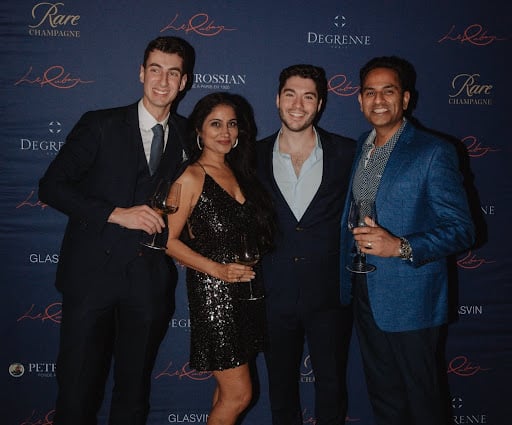
Pieuchot, connecting guests during one of his intimate, French culture-driven wine dinners.
And then New York.
“New York was always the logical next step. If you want to be serious about wine consulting at a high level, you have to be in that market. The density of importers, wholesalers, buyers, sommeliers, collectors, it’s unlike anywhere else. So in 2025, I moved, and I launched a new company.”
Le Ruban LLC positioned itself squarely in the city’s high-end wine sector, working across the supply chain, from importers navigating market entry to luxury boutiques refining their client experience. Within the first year, the firm had secured three major clients.
That’s fast traction in one of the most competitive markets in the world.
“The network came with me. That’s what people underestimate, the relationships built over years in hospitality don’t stay in hospitality. They travel. When I walked into New York, I wasn’t starting from zero. I was arriving with context, with credibility, and with people who already knew how I worked.”
He’s careful to distinguish between speed and shortcuts. “Fast doesn’t mean careless. Every client relationship I’ve built here has been deliberate. In consulting, your reputation is the product. And in New York, word travels in both directions.”
You completed your WSET Levels 1 through 3 with merit. Is formal certification important to you, or is it more about signaling credibility?
“Both, and I don’t think that’s a contradiction. The knowledge is real, you can’t fake terroir fluency in a room full of serious buyers. I wanted the intellectual foundation to match the practical experience I’d already accumulated. Wine is a language, and if you’re going to speak it professionally, you should speak it properly.”
“But yes, the credential matters too. When it comes to advising companies, trust is essential. You build it however you can, through relationships, through results, and sometimes through a certificate on the wall that tells someone you did the work. All of it counts.”

Adrien Pieuchot, always looking beyond the horizon, already focused on what comes next.
What does thirty look like from where you’re standing?
“Like a starting point.”
He pauses, and for the first time in the conversation, he seems to be choosing his words with particular care.
“I’ve compressed a lot into a short time: acquisition, scaling, exit, experiential concepts, consulting. But I don’t think of that as an achievement to rest on. Each of those things was preparation for the next. The restaurant in Huntington Beach taught me operations. The one in San Diego taught me systems. The dinners taught me how to build an audience and a feeling. New York is teaching me how to operate inside a market that doesn’t forgive weakness.”
“I’m not looking back at what I’ve done. I’m asking what the next layer is. That question is what keeps everything moving.”
Author: Thibaud Hue is a French journalist and writer covering politics, society, and contemporary culture, with a particular interest in the social and economic transformations shaping modern France. Based in Paris, his work explores the intersection of public life, media, and national identity through long-form reporting and commentary.