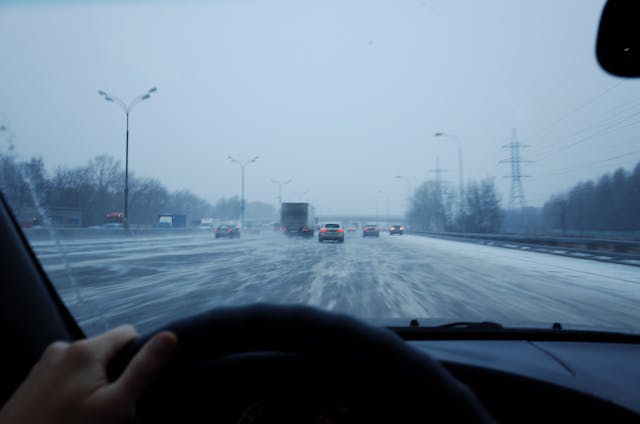
When most Americans think of dangerous winter driving, they picture white-out blizzards, black ice, and snow-packed highways. But a comprehensive analysis of National Highway Traffic Safety Administration from DeMayo Law Offices crash records from 2019 through 2023 tells a very different story, one that demands a fundamental reassessment of how drivers, safety officials, and courts evaluate winter road risk.
Of the 16,546 winter crash deaths during the study period in which an atmospheric condition was recorded, snow-related crashes accounted for just 1,305 fatalities, or 7.9% of the total. Extreme winter events, including sleet, freezing rain, freezing drizzle, and blowing snow, each represented less than 1% of recorded winter fatalities individually. The storms that dominate weather forecasts and public warnings are, statistically speaking, not the conditions killing the most people on winter roads.
The leading atmospheric condition linked to winter traffic deaths was cloudy or overcast weather, responsible for 9,302 fatalities, 56.2% of all recorded winter crash deaths across the five-year period. Rain or mist ranked second, accounting for 5,494 deaths, or 33.2% of the total. Together, these two commonplace, non-emergency conditions account for nearly 90% of all documented winter traffic fatalities in the dataset. This is not a statistical anomaly. It is a structural feature of winter driving risk that reflects how most drivers fundamentally misread the danger in front of them.
The mechanism is well understood, even if its implications are underappreciated. Overcast skies reduce contrast and flatten visual depth perception, making it harder for drivers to judge distances, detect road edges, and identify hazards ahead. Without the obvious visual cues of a snowstorm, most drivers make no behavioral adjustment — they maintain highway speeds, keep standard following distances, and divert attention to phones, navigation systems, and passengers as they would on any other day. Meanwhile, the road beneath them may be wet, cold, and far less forgiving than it appears.
Rain and mist compound the problem. Wet pavement reduces tire traction and significantly extends stopping distances, particularly when ambient temperatures hover near freezing and roads transition between wet and icy without warning. The Federal Highway Administration has documented that 24% of all weather-related vehicle crashes occur on snowy, icy, or slushy pavement, and an additional 15% occur during active snowfall or sleet. But this data, frequently cited in public safety messaging, can obscure the far greater share of crashes unfolding in conditions drivers consider manageable.
“The data consistently shows that people are dying in conditions they didn’t think were dangerous. That perception gap is not just a public safety problem — it is a legal one. When a driver fails to adjust their speed or attention in wet, low-visibility conditions, and someone is killed or seriously injured as a result, that failure carries real legal consequences.”
The seasonal timing of these deaths reinforces the pattern. December consistently records the highest winter fatality totals, 16,805 deaths across the five study years, driven not by the most severe storms, but by the convergence of high traffic volume, reduced daylight, increased nighttime driving, and the subtle but persistent hazards of early winter weather. It is a month when conditions routinely shift between rain, mist, overcast skies, and brief icing events, and when drivers accustomed to fall conditions have not yet recalibrated their behavior for winter.
March presents a different but equally dangerous profile. With 14,917 fatalities across the study period, the final month of meteorological winter remains highly lethal as freeze-thaw cycles produce slushy, unstable road surfaces and drivers begin abandoning the caution they maintained during January and February. Roads that appear clear and dry in the afternoon may refreeze overnight without warning, catching morning commuters entirely off guard.
For personal injury litigation arising from winter crashes, the atmospheric data carries significant implications. The prevalence of fatalities in non-extreme conditions strengthens the legal argument that dangerous driving in overcast or wet weather constitutes negligence, not an accident attributable to unforeseeable road conditions. Drivers have a legal duty to adjust their behavior to match road conditions, regardless of whether those conditions are dramatic or mundane. When they fail to do so, and someone is seriously injured or killed, that failure is actionable.