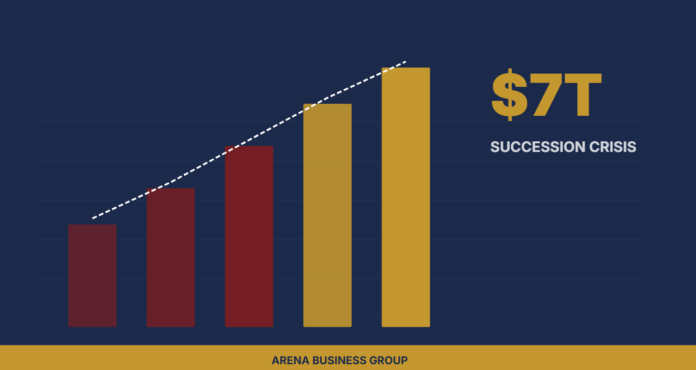
10,000 baby boomers retire every day. Most of them own businesses. Almost none of them have a plan.
Here is the thing about a crisis: it does not announce itself with a press conference. It builds slowly, in dentist offices and retirement parties and quiet conversations between spouses at 11 p.m. And right now, across North America, the largest wealth transfer in human history is unfolding. Most of the people at its center have no plan.
The numbers are staggering. According to the Exit Planning Institute, roughly 4.5 million privately held businesses in the United States are owned by baby boomers. Their combined enterprise value approaches $10 trillion. Within the next decade, the majority of these owners intend to exit. The problem? Fewer than 20 percent have a written transition plan. Of those who do, most have never pressure-tested it against actual market conditions.
This is not a future problem. It is a now problem. Behind each retirement is a business: a plumbing company in Ohio, a logistics firm in Texas, a chain of dental offices in Florida. Each will need to change hands. The question is not whether this transition will happen. It is whether it will happen on the owner’s terms or the market’s.
| A well-documented business takes 18 to 24 months to prepare for market. Wait too long, and the options shrink to one.
This gap between intention and readiness is what Arena Business Group has built its entire model around. While financial advisors focus on the transaction, the sale, the multiple, the closing, Arena focuses on what comes before: making the business transferable in the first place.
The concept sounds simple. A business is worth what someone will pay for it, and buyers pay more for companies that run without the founder. But the execution is anything but simple. It requires documenting processes that exist only in the owner’s head. Building management teams that can make decisions independently. Creating systems that scale without the gravitational pull of one person.
Arena calls this the Transferable Method: a five-phase framework that takes a founder-dependent operation and rebuilds it as a self-sustaining enterprise. Align the leadership team. Map the critical processes. Document them to a standard a new hire could follow on Day One. Automate what can be automated. Then scale.
The results speak in the language buyers understand. A business at Documentation Level 0, where all knowledge lives in the founder’s head, typically trades at 2 to 3 times EBITDA. A business at Level 4, with fully documented systems and a functioning management team, can command 6 to 8 times or higher. On a company earning one million in EBITDA, that is the difference between a $2 million exit and an $8 million one.
But the crisis is not just about money. It is about what happens to the 60 million Americans employed by boomer-owned businesses. When a business fails to sell, or sells in a fire sale, jobs disappear. Communities lose tax revenue. Supply chains develop gaps. The economic ripple effects are incalculable.
The traditional advisory model has not kept pace with the scale of the problem. Most M&A advisors engage at the point of sale, optimizing a transaction that is months away. Wealth managers focus on what happens to the proceeds. Neither addresses the multi-year process of actually preparing the business to survive its founder’s departure.
Arena’s approach is built for this specific gap. Their advisors work with business owners for 12 to 36 months before any transaction, implementing the systems, documentation, and team structures that drive valuation. It is less like a consulting engagement and more like an operating system installation.
The clock is ticking. The first wave of boomer exits has already begun, and the pace will accelerate through 2030. For the millions of owners who have not started planning, the window is narrowing. The $7 trillion question is not whether this transition will happen. It is how much of that value will survive it.
https://www.arenabusinessadvisors.com/
• •