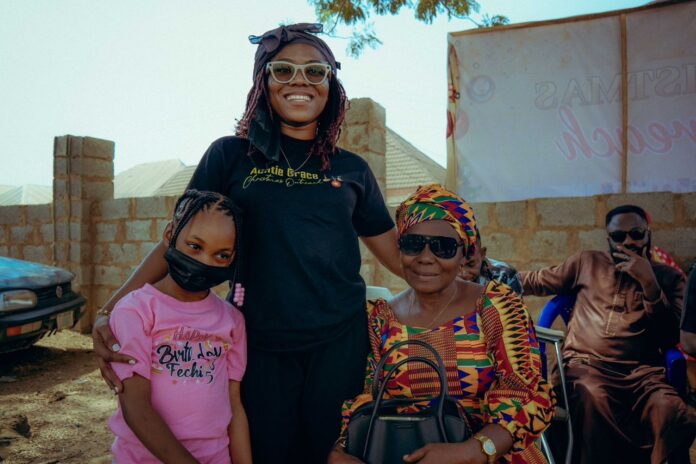
The trajectory from spontaneous volunteerism to structured non-governmental intervention represents a critical juncture in development practice. This article examines the eight-year evolution of a community-driven outreach initiative that has culminated in the establishment of Grace To Grow (G2G) Empowerment Foundation, demonstrating how persistent engagement with marginalised communities can inform and shape comprehensive empowerment frameworks.
Genesis and Early Implementation (2016-2019)
Commencing in 2016, the Christmas outreach initiative emerged as a grassroots response to educational and nutritional vulnerabilities observed in rural Nigerian communities. Operating initially under the auspices of Auntie Grace Plug Ltd, a registered general merchandise enterprise, the programme served as a corporate social responsibility (CSR) mechanism, thereby illustrating the potential for private-sector engagement in community development before the formal establishment of an NGO.
The intervention adopted a dual-focus approach: educational support through comprehensive back-to-school provisions, and household food security enhancement targeting particularly vulnerable demographics. This split strategy acknowledged the interconnected nature of educational access and household economic stability, recognising that material deprivation constitutes a significant barrier to educational participation and outcomes.
Programmatic Components and Beneficiary Targeting
The educational component distributed holistic back-to-school packages encompassing essential learning materials, including school bags, writing instruments, mathematical sets, and notebooks, alongside practical necessities such as water bottles, sandals, and umbrellas. This comprehensive approach surpassed mere symbolic gestures, addressing the multifaceted material requirements that determine consistent school attendance and effective learning engagement among primary and secondary school pupils.
Concurrently, the food security intervention targeted women, with particular emphasis on widows and nursing mothers, recognising their disproportionate vulnerability to economic uncertainty (precarity) and their pivotal role in household welfare. The provision of staple foods (rice, cassava flour, spaghetti), cooking essentials (palm oil, seasoning agents, salt), and household maintenance supplies (detergents, cleaning agents), alongside critical personal care items (sanitary pads, infant diapers), reflected an understanding of the compound deprivations affecting female-headed and vulnerable households.
Institutional Challenges and Legitimacy Constraints
Despite consistent implementation across multiple communities, the initiative encountered recurring institutional barriers. The absence of formal NGO status generated persistent legitimacy shortfalls, manifesting in community scepticism and, unexpectedly, inflated expectations. Village leadership and community gatekeepers frequently questioned the initiative’s organisational affiliation, with the volunteer designation triggering both suspicion about sustainability and, occasionally, unrealistic demands predicated on assumptions about institutional capacity.
This legitimacy gap intensified following the COVID-19 pandemic, during which operations were necessarily suspended (2020), resuming only in 2021. The interruption underscored the fragility of informal development interventions and highlighted the necessity for institutional frameworks capable of weathering systemic disruptions while maintaining community trust and operational continuity.
Strategic Transition: From Ad Hoc Intervention to Systematic Empowerment
The accumulated experience of navigating community reception dynamics, coupled with recognition of the limitations inherent in annual, time-bound interventions, necessitated a fundamental strategic reconsideration. Rather than merely formalising the existing outreach model through NGO registration, the conceptualisation process deliberately expanded the programmatic scope to encompass year-round, multidimensional empowerment initiatives.
This strategic evolution gave rise to Grace To Grow (G2G) Empowerment Foundation, formally registered in Nigeria in 2025 with anticipated full operationalisation in 2026. The foundation’s mandate extends substantially beyond the originating Christmas outreach, articulating five interconnected objectives that reflect contemporary understanding of sustainable development and empowerment paradigms.
The G2G Empowerment Framework
The foundation’s objectives constitute a comprehensive empowerment architecture:
Women’s Holistic Development: Creating pathways for multidimensional advancement encompassing career progression, leadership cultivation, and personal growth, thereby addressing the structural barriers that constrain women’s agency and achievement.
Skills Development in Marginalised Communities: Ensuring equitable access to capacity-building opportunities that enhance both economic productivity and quality of life, recognising that skills acquisition constitutes a fundamental mechanism for poverty reduction and social mobility.
Advocacy for Inclusion and Equal Opportunity: Engaging stakeholders across sectors to influence policy frameworks and institutional practices that systematically disadvantage women and marginalised populations, thereby addressing root causes rather than merely symptoms of inequality.
Mentorship Network Establishment: Constructing structured guidance mechanisms connecting emerging generations with experienced practitioners across professional, educational, and personal development domains, thus facilitating knowledge transfer and expanding opportunity horizons.
Mental and Emotional Well-being Promotion: Developing interventions that cultivate emotional intelligence, psychological resilience, and self-efficacy among youth, acknowledging that cognitive and material development must be accompanied by psychosocial support for holistic empowerment.
The annual Christmas outreach programme will continue as a cornerstone G2G initiative, now operating under formal institutional guidance. This continuity serves multiple functions: maintaining established community relationships, honouring the programme’s grassroots origins, and providing tangible, immediate relief alongside longer-term empowerment initiatives. However, the outreach will now function within a broader ecosystem of year-round programming, thereby transcending the limitations of periodic intervention.
The 2026 outreach cycle will thus represent a pivotal transition, marking the first implementation under the foundation’s formal NGO status and inaugurating the foundation’s expanded mandate. This dual significance positions the 2026 outreach as both culmination and commencement, the fruition of eight years of community engagement and the launching point for systematic, sustained empowerment work.
The evolution from voluntary community service to institutionalised empowerment programming exemplifies how persistent grassroots engagement can inform and necessitate more comprehensive development frameworks. Grace To Grow Empowerment Foundation represents not an abandonment of the originating outreach vision but instead its natural extension and maturation, transforming seasonal intervention into a sustained institutional presence capable of addressing the multifaceted, interconnected challenges facing marginalised communities. The foundation’s 2026 operationalisation promises to leverage eight years of community trust and operational learning while opening up to external bodies for partnership, resource generation, and institutional legitimacy toward holistic, sustainable empowerment outcomes.